Showing posts with label Japan. Show all posts

Sunday, 13 September 2020

THE ANNOYING DEER OF NARA

 THE NARA DEER

NATIONAL TREASURES BUT PESKY

There are some 1,500 deer in Nara Park but it seems like many more as they are everywhere.Nara Park is over 500 HA and you will find deer roaming through the park unchecked.They are Silka Deer and for many years were regarded  as sacred as the person Takemi Kajuchi no Mikoto enshrined in Kasuga Taisha Shrine apparently rode there on a  sacred deer and the animals were regarded as 'helpers of the Gods'. Not only do they smell, but they can be a problem seeking the 'deer crackers', a rice and wheet cracker sold by vendors to feed the deer.Over 150 people are injured by deer annually.The one place they seemed to be excluded was the Todai-Ji, the largest wooden temple housing the very large Buddha (15 metres). Nara is very interesting and historically significant place and worthy of a visit, if you put up with the deer.


Getting to Nara is easy. Depart form th Osaka Namba train station and it usually takes about 30 minutes.Map provided with thanks by Visit Nara Tourism


Monday, 31 August 2020

Glover Garden-Nagasaki Hstory

 THOMAS BLAKE GLOVER

THE HISTORY OF NAGASAKI

Nagasaki is one of the more interesting cities in Japan and steeped in history. Apart from the cultural diversity and the influences from the Chinese, Dutch and British (for over 230 years it was the only port of entry by foreigners into Japan) there is the dropping of the second Atmic Bomb on August 9, August 1945, three days after the bombing of Hiroshima..

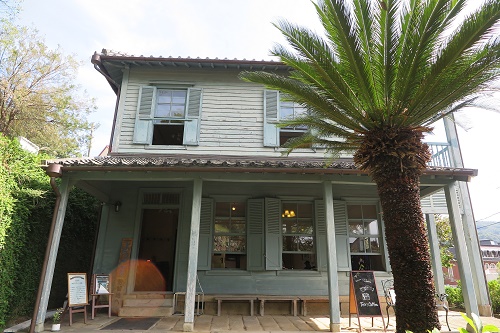
A must see in Nagasaki is GLOVER GARDENS where  Thomas Blake Glover built his home on the hill overlooking the harbour and today it is the oldest  western building in Japan.


Map courtesy of Nagasaki City Tourism

Sadly when visited Glover House was under renovation but there is much to see in the garden and surrounding areas.

THOMAS BLAKE GLOVER

Glover was Scottish and at age 21 crossed from Shanghai to Nagasaki and commenced work selling Japanese Green Tea.Two years later he formed his company, Glover & Co. He went on to assist the toppling of the Tokugawa Shogunate and established good relationships with the Meiji government and was involved in ship builing and some of the first ships for the Imperial Japanese Navy. He was responsible for bringing the first Dry Dock to Japane and opening up coal mining. His involvement with ship builing led to the formation of MITSUBISHI CORPORATION. He also helped founder beer making that later became KIRIN BREWERY COMPANY


Cortesy Nagasaki Travel-Glover House


Monday, 27 July 2020

A SUICA CARD--ESSENTIAL FOR TRAVEL IN JAPAN

SUICA CARD
MAKES TRAVEL IN JAPAN EASIER

 Travel in Japan is now far easier than it once was, with good web sites in English, and most instructions at train stations and bus terminals in English; but not always.Getting around Japan by train or bus , using the Suica Card is so much easier that trying to work out the correct fare and pay cash.Sometimes it is not clear if in fact you can understand the often complex fare and line guide.


 A Simple Guide For Foreigners

The Suica Card is a pre-paid smart card for use on public transport (metro, trains, buses and monorail).The card is debited for every trip when you touch the card reader at the entrance to the station or track or on the bus. It does not work on express trains, Shinkansen , longer distance buses or the Airport Shuttle so check  before use.

It comes loaded with Yen 2,000 and there is a Yen 500 deposit, refundable at anyJR East Station in Tokyo, You can top up at ticket machines , which have an English capability but note it is CASH ONLY unless you have a JR Credit Card which is unlikey. (There are still some odd rules and situations that are not explainable).  The card is not registered in your name so anyone can use the card. You can check the credit on the card reader or at the ticket machine.

If you mess up, go to the nearest attendant and they will do their very best to assist. So too any Japanese person, but you need to ask.


Saturday, 25 July 2020

NAGASAKI-WALKING THROUGH HISTORY OF THE ATOMIC BOMB OF AUGUST 9, 1945

THE BOMBING OF NAGASAKI 

AUGUST 9, 1945
The Nagasaki Atomic Bomb Museum And Other Places

Nagasaki is a place of significant history, none more so than the events of August 9, 1945. A visit to Nagasaki  must include the stark reminder of the use of nuclear weapons that ended  World War II, six days later. It is noty the only reason as there is the history ofthe Edi Period where Nagasaki was the only port of entry into Japan for 220 years.There is also the diverse cultural influences of the Chinese , Dutch and English on the town, it architecture and activities. This is a bried look at the Nagasaki Atomic Bomb Museum and the other places nearby that a remiders of the stark period in history.


HISTORY

The United Stated detonated a nuclear weapon over Nagasaki on August 1945.

The city of Nagasaki had been one of the largest seaports in southern Japan, and was of great wartime importance because of its wide-ranging industrial activity, including the production of war materials and ships and the location of the Mitsubishi Shipyards and Arms Plants. Nagasaki was an important industrial city but because of geography, difficult to locate at night. It was however bombed with conventional weapons a number of times. The city was also well defended by Anti-Aircraft batteries. Unlike Hiroshima, the buildings and factories were mostly old-fashioned Japanese construction, mostly timber. Nagasaki has also grown with residences next to factories and on the day of the bombing thee were over a quarter of a million people in the town. There were also 400 Allied prisoners of war.

Nagasaki was the secondary target on that night and because over Kokura, the primary target Bockscar carrying Fat Man diverted to Nagasaki. The bomb was estimated to have killed between 39,000-80,000 people immediately and during the days and weeks to follow.The bomb blast covered an area of 1.6 KM. Japan surrendered to the Allies on August 15, six days after Nagasaki, ending World War II

No Coments--Just Photos


Dejima-The Only Access To Japan For 220 Years

DEJIMA
NAGASAKI JAPAN
A Model of the Island within the museum grounds

THE NAME
Dejima means Exit Island

HISTORY

In 1543, the history of direct contacts between Japan and Europe began with the arrival of Portuguese merchants on Tanegashima, probably because of storms. Six years later the Jesuit missionary Francis Xavier landed at Kagoshima.  Hirado was the first port used by the Portuguese traders but they moved in search of a better port. In 1570, a local Shogun, Omura Sumitada ( please call me Bartolomeu as I am Christain) converted to Catholicism and made a deal with the Portuguese to develop Nagasaki and it soon became an open port.  In 1580 Sumitada gave the jurisdiction of Nagasaki to the Jesuits, and the Portuguese obtained the apparent monopoly on the silk trade with China through Macau. Seems he may have had some financial interest, but only cynical supposition

Along came Shogun Iemitsu in 1634, and ordered the construction of the artificial island to house the Portuguese traders and to prevent Christianity from spreading. The same Shogun made many rules regarding Japan’s contact with the outside from 1633 to 1639 but an uprising (mostly converted Christians) resulted in the Shogun expelled the Portuguese in 1639.The Dutch East India Company had operated  a trading post on the island of Hirado, and they became the sole access to Japan trade  and operated for some 33 years. Without the Portuguese trade Nagasaki suffered economically and Dejima was a failed commercial operation and the Dutch were forced to move to Dejima. From 1641 only Dutch and Chinese ships were allowed to come to Japan and Nagasaki Harbour was the only port of entry.

 For two centuries and most of the Edo Period, Nagasaki became the only link with the world and only trading port in Japan. This was abolished in 1854 with the Treaty of Kanagawa, singed in Yokohama under some force and opening up the ports of Kakodate and Shimoda and the establishment of an American Consul in Japan (Thanks to Commodore Mathew C Perry and his fleet of four gunships). 

Sadly, this was the end of Dejima and what was open to the sea was reclaimed (as you can see today it is surrounded by buildings and no sight of the water.Today Dejima has been restored and is an intersting historical museum.Too bad it could not have been retained on the tip of the Nagasaki Peninsula, but there you go.


The Entrance

The island is quite small at 9,000 share meters


 Sugar warehouse

The bell was rung at Noon and when shipments arrived or were negotiated

Model of Dutch Sailing Vessel Friesland
Bronze gun dating back to 1640 (Amsterdam Anno) found in Nagasaki Harbor

Senior local Japanese managed the foreigners from these offices.
Decorations and old stone work

Dutch Housing
The Dejima Tree--mid 19th century from Java
There is a tram system in Nagasaki and we stayed at

HOTEL FORZA  NAGASAKI

It was on the tam line and in an interesting market and restaurant area.(Hamanmachi)